
Equality Sector Enterprise Development Research
Can more enterprise development grant funding and support help equality focused VCSE organisations become stronger, more sustainable and more independent? What kind of targeted enterprise development support do they need and are they getting it? What more can enterprise grant funders and other trusts and foundations, who want to support equality organisations, do?
Collaborative research to inform future funding and policy
EIIP is partnering with Equally Ours and Access - the Foundation for Social Investment, and others, on research and consultation to answer these questions. We will publish and share our findings with policy makers and funders and also use them to inform the development of a National Enterprise Development Strategy for the VCSE Equalities sector.
As a first step we asked VCSE equalities organisations, both frontline and infrastructure, working nationally and in different regions/places and led by and for a range of different groups and communities including women and girls, LGBTQ + people, disabled people and black and minoritised ethnic groups, to complete a survey and take part in a consultation workshop.
Initial Findings from Equality Organisations Enterprise Development Survey
109 organisations with a core mission to advance equality, and led by and for their beneficiaries, completed the survey.
Respondent organisations work with, and for, people from Black and Minoritised Ethnic groups (22%), women and girls (20%), LGBT+ people (17%), children and young people (10%) and disabled people (9%), as well as other groups addressing social exclusion, economic disadvantage, poverty and with a pan equality or intersectional discrimination focus.
73% had Boards comprised at least 50% of people from their primary beneficiary group - and 41% had staff teams with 50%+ primary beneficiary group members.
83% of respondents deliver direct services to beneficiary groups, with a further 61% working with beneficiaries to understand challenges and participate in solutions. Just over half work on public education and awareness, and advising and supporting to other organisations on tackling inequality, respectively.
72% of activity of respondents focuses on health, 61% on participation and 54% on education.
Responses were spread across the English Regions and UK nations, from organisations with diverse legal forms. Many respondents are small organisations - nearly half of respondents had turnover last year of under £100k; a fifth turnover less than £20k. However, 16% had a turnover of more than £500,000 and 7% a turnover of more than £1m.
Results showed that:
There is a lot of interest in growing income from trading: 70% of respondents. Of those that didn’t express this, most are large (£1m+ turnover). There is also a significant lack of knowledge of how this can be achieved, and interest in support with addressing this.
The vast majority of respondents currently generate minimal or no income from trading and are grant dependent. Although those that do generate over 50% of income from trading are mixed in terms of turnover size, with most having turnover under £100k.
Most respondents haven’t had an enterprise development grant, know little or nothing about them, and aren’t aware of being targeted or signposted to them by current or previous grant funders. But when asked about appetite for the types of funding and support enterprise development grants can offer, there is significant interest, and more generally in help with enterprise development and routes to market.
The data on enterprise development grants indicates they’ve been particularly useful for sustaining/growing and testing new approaches and projects. And are highly recommended by the small proportion who’ve directly experienced them.
Enterprise Development Grants: Information and Consultation Workshop for Equality Organisations
In May 26 we also ran online EDG further information and consultation workshop for equality organisations who completed the survey and others.
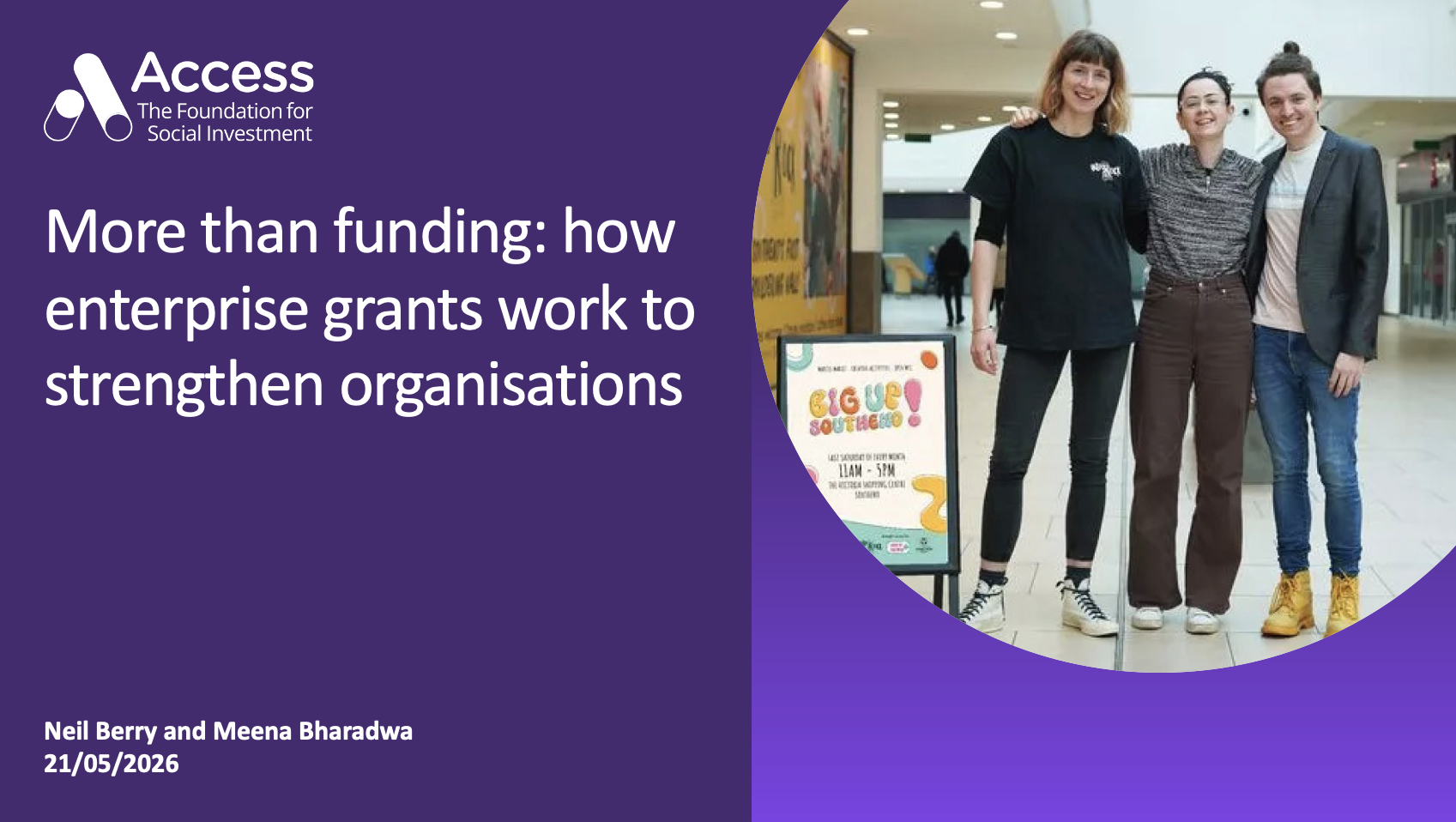
The session included a presentation from Access - The Foundation for Social Investment on EDG’s and Equality Organisations, including current sources of EDG’s.
You can view the presentation by clicking on the image below:
Findings from the Workshop
Organisations that had received funding to develop a proof of concept found that accessing the next stage of support to actually implement the model was significantly harder, creating a gap between development and delivery.
The capacity to transition from volunteer-dependent to paid-staff models was identified as a critical blocker, with organisations delivering clear impact but unable to build the business infrastructure to sustain it.
Participants had well-developed ideas about what enterprise support would look like in practice - proof of concept funding, capacity to hire, hands-on implementation support - but lacked the routes to access it. They identified common challenges with restricted and competitive funding, and finding capacity to apply.
Next Steps
The next phase of this research incorporates a review of literature and enterprise development funding activity to date, with deeper analysis of funder behaviour and plans in this space.